Sunday Reflection: What Is Education Really For?
AARAI Horizons >> Education>> Sunday Reflection: What Is Education Really For?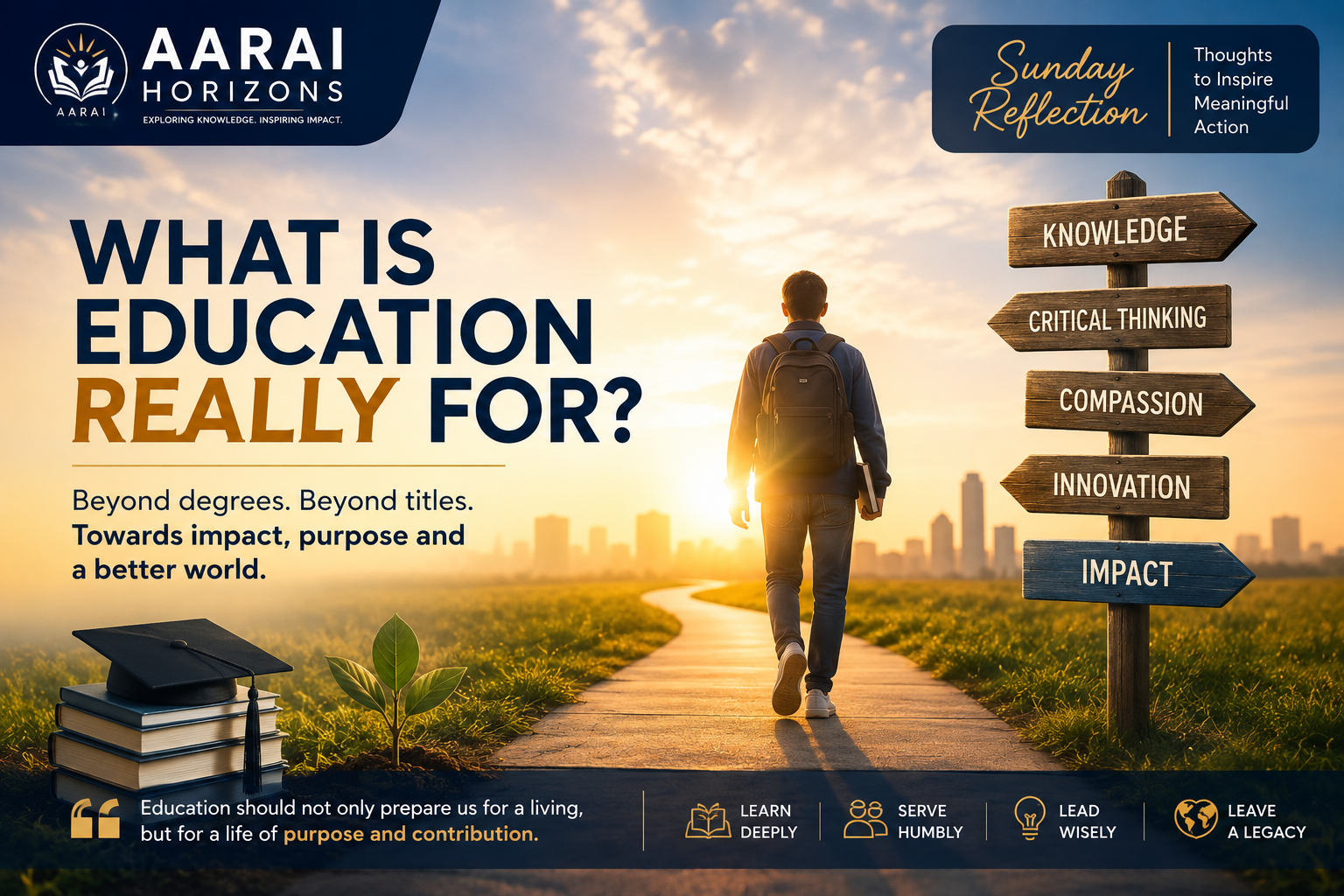
Sunday Reflection: What Is Education Really For?
I have been thinking about education a lot lately.
Perhaps it is because I spend so much of my time around universities, researchers, students, academic writing, conferences, publications, and professional development. The more I observe the world of education, the more I find myself returning to one simple question.
What are we actually trying to achieve through education?
It sounds like a simple question. Yet I am not sure we ask it often enough.
We celebrate graduation ceremonies. We celebrate degrees, master’s qualifications and doctorates. We celebrate promotions, publications, citations, awards, fellowships and academic titles.
And we should.
Behind every qualification is usually a story of sacrifice. Someone stayed up late studying. Someone worked while studying. Someone struggled financially but continued. Someone travelled far from home. Someone failed and tried again. Someone believed that education could change their life.
There is something beautiful about that.
But sometimes I wonder whether we have gradually turned education into a race for credentials.
Who has the highest qualification?
Who has published the most papers?
Who has the highest citation count?
Who has the longest list of certificates?
Who has the most impressive title?
These things can tell us something about a person’s academic journey. But they do not tell us everything about the person.
A person can have a doctorate and still struggle to listen.
A researcher can publish dozens of papers and still produce work that never reaches the community that needs it.
A university can graduate thousands of students every year and still leave many of them wondering what they are actually prepared to do.
And this is where I think we need to pause.
What happens after the certificate?
Imagine a student who spends four years studying public health.
They graduate.
They frame their certificate.
They add the qualification to their name.
But they return to a community where children are still dying from preventable illnesses, families lack basic health information, misinformation spreads rapidly, and people do not know where to seek help.
What does that degree mean if the knowledge acquired never finds its way back to the community?
Or imagine a researcher who spends three years studying a serious social problem.
The thesis is completed.
The paper is published.
The journal article receives citations.
The researcher moves on to another project.
But the community that participated in the research never hears what was discovered.
Did we really complete the journey?
Perhaps academically, yes.
But socially, perhaps not.
This is not an argument against degrees or research. Quite the opposite.
It is an argument for taking them more seriously.
Because education should give us capacity.
Capacity to understand.
Capacity to question.
Capacity to solve problems.
Capacity to create.
Capacity to serve.
Capacity to improve the lives of others.
I sometimes wonder what our universities would look like if we measured impact differently.
What if, alongside asking how many students graduated, we asked how many community problems those graduates helped solve?
What if research institutions did not only celebrate publications, but also celebrated research that changed a policy, improved a service, helped a community, influenced practice, or prevented harm?
What if students were encouraged to ask:
“What problem in my community can I help solve with what I am learning?”
That question could change the way we approach education.
A medical student might begin looking beyond examinations and start asking why people in a particular community delay seeking treatment.
An engineering student might look at the infrastructure challenges around them and begin thinking about affordable solutions.
A psychology student might ask why young people in their community are struggling and what can be done.
A public health student might stop seeing a research project as merely a requirement for graduation and start seeing it as an opportunity to understand and address a real problem.
An education student might ask why children are falling behind rather than simply learning how to pass an examination about educational theory.
This, to me, is where education becomes alive.
Education should change us
I have never believed that education should only fill our heads with information.
It should also change the way we see.
It should make us more curious.
It should make us more thoughtful.
It should make us more willing to listen.
It should make us uncomfortable with ignorance.
It should make us question injustice.
It should make us recognise problems that others have learned to ignore.
And hopefully, it should make us more compassionate.
Because what is the value of knowing a great deal if we become less concerned about the people around us?
What is the value of intelligence without wisdom?
What is the value of knowledge without responsibility?
What is the value of research without impact?
These questions have become increasingly important in a world where information is everywhere and artificial intelligence can produce information faster than any of us could.
Perhaps the future of education will force us to reconsider what really matters.
When information is readily available, wisdom becomes more important.
When AI can generate answers, the ability to ask meaningful questions becomes more important.
When qualifications are increasingly common, what we do with our knowledge becomes more important.
Perhaps we have misunderstood success
I do not think there is anything wrong with wanting a degree, a successful career, a good salary, recognition, or professional advancement.
These are legitimate aspirations.
But perhaps they should not be the entire definition of success.
I would like to see an education system where a successful graduate is not only someone who found a good job.
A successful graduate is someone who can use what they learned to make something better.
A successful researcher is not simply someone with an impressive publication record.
It is someone whose knowledge has made a difference.
A successful professional is not simply someone who climbed the career ladder.
It is someone who used their position to create opportunities for others.
And perhaps a truly educated person is not simply someone who knows many things.
It is someone who knows enough to realise how much they still have to learn.
So, what is education really for?
I don’t think I have a perfect answer.
But after years of learning, teaching, researching and watching people move through different stages of education, I increasingly believe that education should help us become more capable human beings.
People who can think.
People who can question.
People who can create.
People who can solve problems.
People who can work with others.
People who can recognise suffering.
People who can use knowledge responsibly.
And people who are willing to leave the world slightly better than they found it.
Maybe the most important question at the end of our educational journey should therefore not be:
“What qualifications did you obtain?”
Perhaps we should also ask:
“What did your education enable you to do?”
And even more importantly:
“Who became better because you were educated?”
That is a question worth carrying with us.
Because perhaps education is not ultimately about how many letters we can place after our names.
Perhaps it is about what those letters enable us to contribute to the world.
A Sunday Question
Think about the education you have received.
Not your certificates. Not your grades. Not your titles.
How has your education changed the way you think, the way you treat people, and the problems you are now capable of helping to solve?
Perhaps that is where the real measure of education begins.